
Being stuck in Quarantine has got me thinking.
Ethics.
The concept of ethics was confusing to me when I began studying on the BAPP course. As mentioned in my post on 17th February (https://olivia-gracethompson.blogspot.com/2020/02/campus-day-17th-february.html). I struggled to ask questions without answering them. It was an alien concept. I'm someone who enjoys answers. However when I began looking at specific areas I felt required ethical considerations or ethical procedures, I realised that the reason these questions shouldn't be answered is they can't be. There isn't a specific answer or solution to the issues facing the industry.
Something that also stuck in my mind was the idea of 'neutral' being non existent. We all approach ideas from a natural place of bias. This comes from our own personal histories, experience and individual stories. That's why we're so excited when someone agrees with us completely, because there's no way we've been through exactly the same experiences, so to come out with matching opinions seems quite miraculous.
One idea I really enjoyed researching was the ethics around casting. As a jobbing actor getting cast is one of the most important things to my practice. I can't practice if I'm not working. For me, working relies on me getting cast. However in recent years casting has become far more complex than it once was.
For example, take the role of Juliet in Romeo and Juliet. What do we know about her that would help us cast the most appropriate individual? From reading the play we know....
. She is a female.
. She is 13 (nearly 14)
. She lived in the 14th century, in Verona, in Italy.
. She is from a wealthy family.
. Her family are quarrelling with another.
. She falls in love with Romeo.
These things simply cannot be questioned. They are facts, in the original play text, written by William Shakespeare. Knowing these things we're already cultivating an image of our Juliet.
Baring all of these facts in mind, below are a selection of people who have played Juliet.
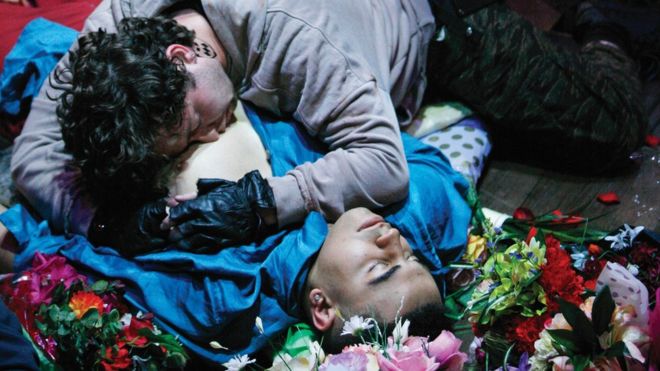
Elliot Kingsley, playing 'Julius' in a genderswap, Romeo and Juliet at the Everyman in Liverpool, 2017

Clare Danes at 'Juliet' in the Baz Luhrman film, Romeo and Juliet, 1996

Cordelia Braithwait as 'Juliet' in Matthew Bourne's Romeo and Juliet, 2020
There are little to no similarities to the above actors to the description of 'Juliet' from the play. One is male, they're all least twice her age and none look like they could have lived in 14th century Italy. So why have they been cast?
There are hundreds of ethical considerations to consider in casting. First and foremost we must serve the truth, but we must still stay inclusive and representative of the multi-cultural society we live in. Representation is important.
I would argue casting a male actually serves the truth of the play more than anything else, originally 'Juliet' would have been played by a male, women weren't allowed on stage.
I would also argue in 2020 we wouldn't be comfortable seeing a 13 year old in the role of 'Juliet'. In 2020,13 year old girls don't marry and embark on sexual relationships behind their parents back. However we still regularly cast a young looking actor.
What ethical procedures need to be followed to ensure we are still serving the story? The truth of the playwrights words? My opinion would be vastly different to someone else's and that's okay.
Recently I watched a production of 'Richard III' at the Donmar Warehouse, named 'Teenage Dick'. In this retelling Richard, or Dick, attends an american-esque highschool. It catapulted the story into a world I recognised. Daniel Monks who played Richard is a disabled actor as is Ruth Madeley, who played Buckingham, or Buck. It was the first time I saw this strain of truth served from a casting perspective. Richard is a disable character, this part of his physical persona feeds his personality. It suddenly made so much more sense as to why he chases power.
But the truth wasn't served across the entire production. Anne had had an abortion, originally Richard kills her child. They were fighting for class president, not the crown. So we're back at square one. What procedures need to be followed to serve the truth?
And if we're going to keep digging, do we even need to serve the truth? It's certainly more exciting not to....
Some questions don't require an answer, just a ponder.
What a great post about ethics. I really enjoyed your analogy about casting in regards to Romeo and Juliet. This really brought to light lots of questions for me to consider. Thank you!
ReplyDeleteLove this post! I love how you compared all of those Juliets, and your analysis was very interesting. Keep well and safe!
ReplyDeleteHi! loved your post. i loved your view on casting and how it is down in modern day. i to have so many questions and discussions about casting and i believe it is such an open topic. I'm still looking for a definition about ethics but i think you're right to say there isn't one and it's all about open ended questions. great post! Stay Safe Chloe x
ReplyDelete